
Flowers
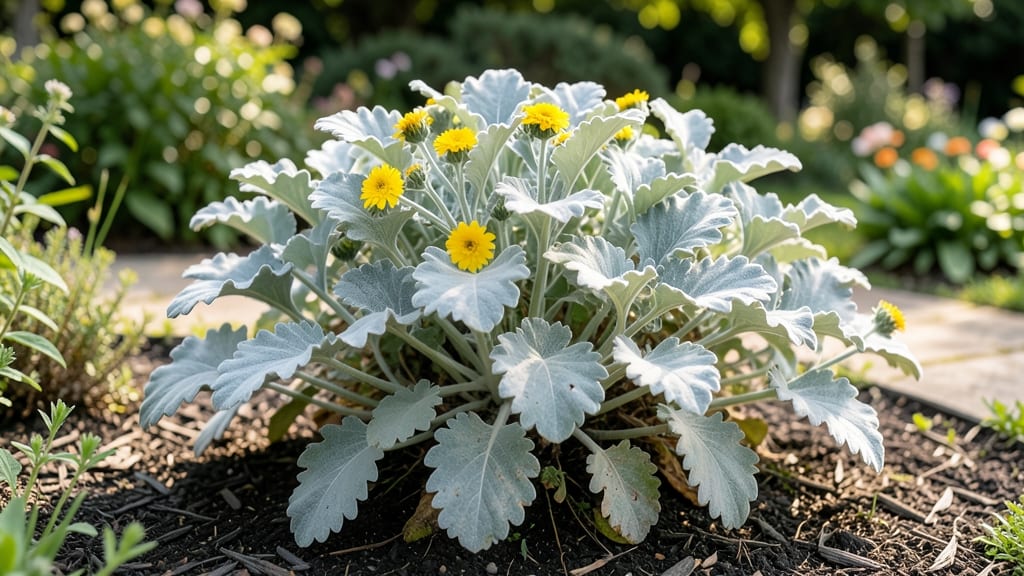
Deciding whether dusty miller is annual or perennial depends on your climate: it thrives as a perennial in USDA zones 5-9 but acts like an annual in colder zones (3-4) due to frost sensitivity, though it often self-seeds prolifically for regrowth. Cold triggers dieback, but roots survive underground until spring warmth returns.
Dusty miller's behavior shifts dramatically with temperature.
In warmer zones, its woolly foliage returns reliably each spring from dormant roots, while colder winters force it to regrow from seeds instead. 🌱 The plant's hardiness varies by cultivar—some varieties handle frost better than others, which is why gardeners in marginal zones often experiment with mulching or container growing to extend its life.
Understanding these patterns helps you choose between planting from seed annually or investing in root protection for perennial growth.
What makes this plant so resilient is its ability to adapt. Even when frost kills the above-ground growth, the root system remains viable until temperatures rise. This survival mechanism explains why dusty miller often reappears spontaneously in garden beds year after year, even when treated as an annual.
The key difference between zones lies in how consistently these roots survive winter conditions without damage.
💡 In This Article
- Why Dusty Miller Dies Back in Cold Climates
- Extending Dusty Miller’s Lifespan in Cold Regions
Why dusty miller dies back in cold climates
Dusty miller (Jacobaea maritima) undergoes dramatic seasonal changes because its cells contain high concentrations of water, which freezes at 32°F (0°C) and damages delicate foliage.
When temperatures drop below 20°F (-6°C), the plant's woolly silver-gray leaves—known for their velvety texture—crystallize and rupture, causing the above-ground growth to blacken and collapse. This frost sensitivity explains why gardeners in USDA zones 3-4 often treat it as an annual, even though the roots remain alive underground.
The plant's survival strategy relies on its deep taproot system, which can extend 12-18 inches below the soil surface. This root structure stores carbohydrates and nutrients during winter, allowing the plant to regenerate when spring temperatures rise above 50°F (10°C).
In warmer zones (5-9), these roots consistently survive winter, making dusty miller a true perennial. The key difference lies in how consistently the roots endure sub-freezing soil temperatures—often -5°F (-20°C) in zone 4—without irreversible damage.
At a cellular level, cold stress triggers a cascade of responses: the plant produces antifreeze proteins that lower the freezing point of its cell fluids, while hormones like abscisic acid help the plant enter dormancy.
These adaptations explain why dusty miller can tolerate brief cold snaps but struggles during prolonged winter conditions. In colder climates, the roots may survive, but the stress weakens their ability to regenerate robust foliage, forcing the plant to rely on self-seeding for continuation.
Consider the visual difference: In zone 7, dusty miller returns each spring with its signature silvery foliage fully intact, while in zone 3, you might see only sparse regrowth or need to replant from seed.
The plant's ability to self-seed prolifically—often producing 500-1,000 seeds per plant—compensates for this limitation, ensuring its persistence even when treated as an annual. This seed-based regrowth is a backup survival mechanism when root survival becomes unreliable.
Another critical factor is soil insulation. In colder zones, the ground freezes deeper, exposing roots to more extreme cold. A 4-inch layer of mulch can raise soil temperatures by 5-10°F, making a significant difference in root survival.
This is why gardeners in marginal zones often use straw or leaves to protect dusty miller during winter, even when the plant behaves as an annual in its natural cycle.
What most gardeners don't realize is that dusty miller's frost sensitivity varies by cultivar. Some varieties, like 'Silver Spray,' have been bred for slightly better cold tolerance, while others, like 'Cotton Ball,' may struggle more in zone 4.
This genetic variation explains why some gardeners in cold climates achieve perennial results while others must replant annually. 🌡️