
Shrubs
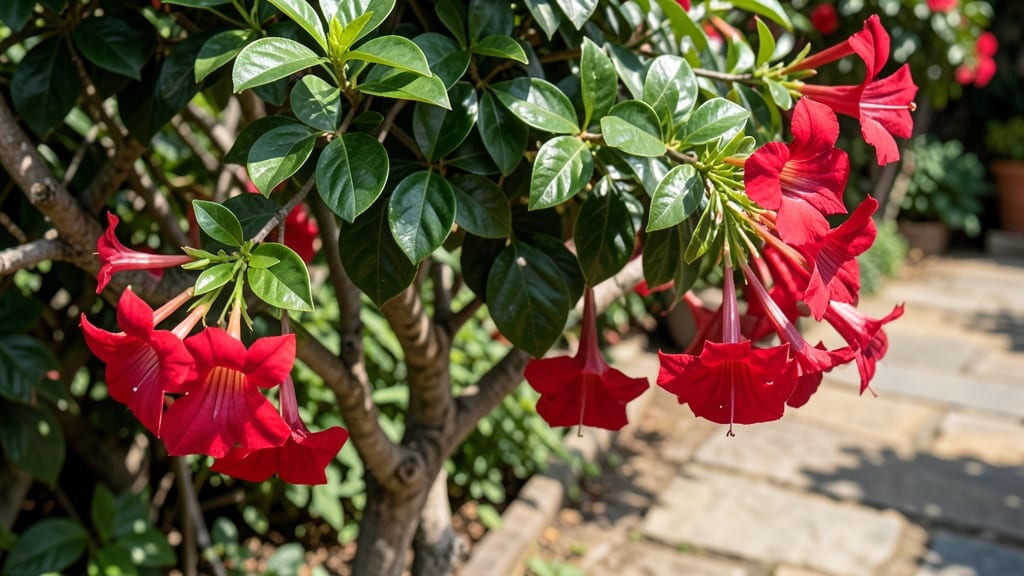
Whether red Mandevilla is annual or perennial depends on your climate: it thrives as a perennial in frost-free zones (USDA 9-11) but must be treated as an annual in colder regions unless you overwinter it indoors or protect its roots from freezing.
This tropical beauty's lifespan hinges on temperature thresholds—below 20°F, its roots suffer irreversible damage. 🌡️ In Zones 9-11, it naturally regrows each spring from dormant roots, while gardeners in Zones 7-8 must intervene by digging up tubers before frost or risk losing the plant entirely.
The key difference? Perennial behavior requires consistent warmth, while annual treatment in colder areas preserves the plant through strategic overwintering.
What's fascinating is how the plant's growth cycle mirrors its native habitat—South America's tropical climates. Without frost protection, even established plants revert to annual behavior, dying back completely each winter. This makes zone selection and winter prep critical for long-term success with red Mandevilla.
💡 In This Article
- How Temperature Zones Determine Red Mandevilla Lifespan
- Overwintering Red Mandevilla in Cold Climates
How temperature Zones determine red Mandevilla lifespan
The red Mandevilla's classification as annual or perennial comes down to its root system's frost tolerance. Native to Brazil's tropical regions, this plant evolved without exposure to freezing temperatures. Its roots contain minimal cold-hardiness adaptations compared to temperate perennials like lavender or rosemary, which can survive 15°F dips.
When temperatures drop below 20°F, the root cells begin freezing, causing irreversible damage to the vascular system that transports water and nutrients. 🌡️
In USDA Zones 9-11, where winter lows rarely fall below 20°F, red Mandevilla behaves as a true perennial. The plant enters a natural dormancy during cooler months, with above-ground growth dying back while the roots remain alive underground.
When spring temperatures rise above 60°F, new shoots emerge from these surviving roots—a process called regrowth from dormant buds. This is why established plants in warm climates can live for decades with minimal care.
The dividing line occurs in Zones 8 and below, where winter temperatures frequently drop to 10-15°F. At these levels, even the hardiest Mandevilla roots can't survive prolonged exposure. The plant's growth habit shifts from perennial to annual because the root system simply can't endure the freeze-thaw cycles.
What's particularly interesting is how this mirrors the plant's native environment—its survival strategy depends entirely on consistent warmth, not cold resistance. 🌱
Botanically speaking, red Mandevilla falls into the category of tender perennials, similar to bougainvillea or oleander. These plants can live multiple years in ideal conditions but lack the cold tolerance of true perennials.
The key difference lies in their dormancy mechanisms: while hardy perennials store energy in underground structures like rhizomes, Mandevilla's roots are more delicate, requiring protection from frost to persist through winter.
What most gardeners don't realize is that even a single night below 28°F can kill Mandevilla roots, regardless of how established the plant appears. The plant's tropical origins mean its cellular membranes lack the protective compounds found in cold-hardy species.
This is why zone selection is critical—gardeners in marginal zones (like Zone 8b) often see their Mandevilla die back completely unless they take proactive measures. 💥
Understanding this mechanism helps explain why some gardeners report their Mandevilla returning year after year in Zone 8, while others lose it completely. The difference often comes down to microclimates—plants near heat-retaining structures (like brick walls) may survive slightly colder nights, while those in open areas face higher risk.
This creates the illusion of perennial behavior where annual treatment would be more accurate scientifically.