
Advice
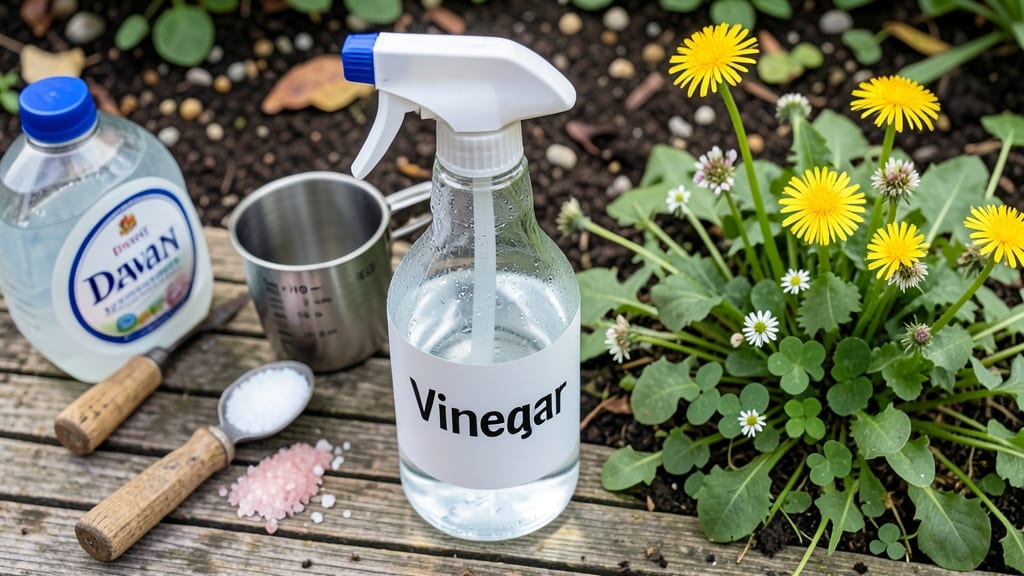
A vinegar, Epsom salt, and Dawn dish soap weed killer eliminates unwanted plants by leveraging acetic acid to burn weed foliage, Epsom salt to disrupt root systems through magnesium overload, and Dawn's surfactant to penetrate protective leaf coatings. For best results, apply during sunny conditions but avoid spraying edible plants or during dry spells.
This homemade weed killer targets weeds at both their leaves and roots, making it more effective than vinegar alone. 🌱 The combination creates a double-edged attack: while vinegar's acidity breaks down cell walls, the Epsom salt dehydrates roots by overloading them with magnesium.
Dawn's gentle surfactant ensures the mixture clings to leaves longer, maximizing absorption. I've found this works best on young weeds or small patches—older weeds with deep roots may require multiple applications. Always test on a small area first, as some plants are more sensitive than others.
Timing matters just as much as the mixture itself. Early morning applications prevent evaporation before the sun can activate the vinegar's acidity. 🌞 Avoid windy days, as the spray can drift onto desirable plants.
For best results, I recommend mixing 1 gallon of white vinegar with 2 tablespoons of Epsom salt and 1 teaspoon of Dawn dish soap. This ratio gives you enough volume to treat about 10 square feet of weed-infested area.
💡 In This Article
- How Vinegar, Epsom Salt, and Dawn Kill Weeds
- Safety and Application Tips for Homemade Weed Killer
How vinegar, Epsom salt, and Dawn kill weeds
The real power of this weed killer lies in how each ingredient attacks weeds differently. Vinegar's acetic acid (typically 5-8% concentration) works like a chemical scalpel, breaking down the waxy cuticle layer on leaves that protects against moisture loss.
Once this barrier is compromised, the acid seeps into plant cells, causing them to swell and burst through a process called osmotic shock. This is why you'll notice weeds wilting within hours of application—it's not just drying out, but actively being destroyed at a cellular level.
Epsom salt (magnesium sulfate) plays a secondary but crucial role by creating a magnesium overload in weed roots. Most weeds can't process excess magnesium, so they become dehydrated from the inside out. The salt also creates an ionic imbalance, forcing roots to work harder to expel the excess minerals.
This is particularly effective against broadleaf weeds like dandelions and clover, which have shallow root systems. The combination of vinegar's foliar damage and Epsom salt's root disruption creates a two-pronged attack that's more effective than either ingredient alone.
Dawn dish soap acts as the delivery system's secret weapon. Its surfactant molecules reduce surface tension, allowing the vinegar solution to spread evenly across leaves and penetrate their protective coatings.
Without the soap, vinegar would simply bead up and roll off many plant surfaces. 🌿 What's fascinating is how the soap doesn't harm beneficial insects—it's specifically formulated to be gentle on skin while being tough on plant cuticles.
This makes the mixture safer for your garden ecosystem compared to commercial herbicides that often kill everything they touch.
Here's where the science gets particularly interesting: the combination works best when applied to young weeds. Mature weeds with thick stems have developed more protective layers that can partially resist the acetic acid's effects.
For example, a 2-inch dandelion will typically die within 24-48 hours of treatment, while a 6-inch plant might take 5-7 days to show complete wilting. The Epsom salt's root disruption becomes especially noticeable after 3-5 days, when you'll see new growth stop completely.
What most gardeners don't realize is that this mixture creates a pH shock. Vinegar alone drops the pH to around 2.5-3.0, but when combined with Epsom salt (which is slightly alkaline), the resulting solution has a more complex chemical interaction.
The magnesium ions in the salt help buffer the extreme acidity slightly, which actually makes the vinegar more effective at penetrating plant tissues over time rather than creating an immediate burn that would seal the plant's defenses.
For visual evidence of how this works, try this experiment: spray a small patch of weeds with just vinegar, then another with the full mixture. You'll notice the vinegar-only area shows some browning but may recover if rain dilutes it.
The full mixture area will show uniform browning within hours, with leaves curling inward as the cells collapse. This visual difference demonstrates why the combination is superior to single-ingredient solutions.