
Flowers
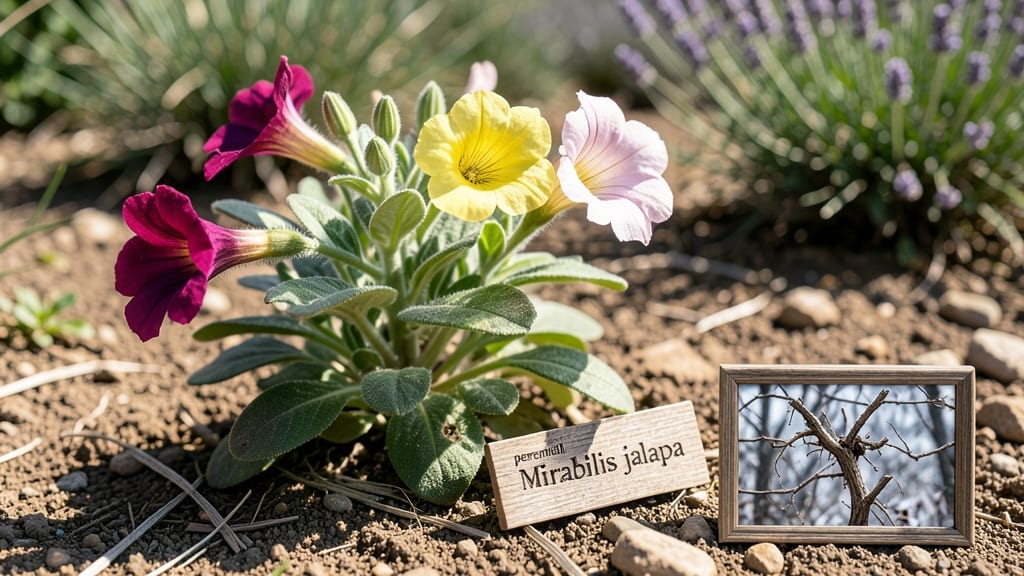
Four o’clock flowers (Mirabilis jalapa) are perennials in warm climates but typically grow as tender perennials or annuals in cooler regions, regrowing from their deep, tuberous roots each season if conditions allow.
These vibrant flowers earn their name from their habit of opening in the late afternoon—around 4 p.m.—but their real secret lies underground. 🌱 The thick, tuberous roots act like natural storage units, storing energy to fuel new growth when temperatures warm again.
In frost-prone areas, the aboveground foliage dies back, but the roots remain dormant until spring, when they sprout fresh stems and blooms. This makes them technically perennials even in cooler zones, though gardeners often treat them as annuals due to their seasonal die-back.
What sets them apart is their resilience. Unlike true annuals that complete their entire life cycle in one season, four o’clock flowers have the built-in ability to persist through multiple growing seasons when conditions are right.
This adaptability is why they thrive in USDA zones 9-11 as hardy perennials, while gardeners in colder regions can still enjoy them by protecting the roots over winter or propagating new plants each spring.
💡 In This Article
- Four O’Clock Flower Growth Habits: Perennial vs. Annual Behavior
- How to Encourage Four O’Clock Flowers to Regrow Year After Year
Four o’clock flower growth habits: perennial vs. annual behavior
The key to understanding four o’clock flowers (Mirabilis jalapa) lies beneath the soil. These plants store carbohydrates and nutrients in thick, tuberous roots that can grow up to 6-8 inches deep. These roots act like underground batteries, allowing the plant to survive harsh conditions—including frost—by entering dormancy.
When temperatures drop below 32°F, the aboveground stems die back, but the roots remain alive, waiting for warmer weather to restart growth. This is why they're classified as tender perennials in cooler climates.
In warmer regions (USDA zones 9-11), the roots thrive year-round, producing continuous blooms with minimal die-back. The plant’s natural dormancy cycle is triggered by temperature shifts rather than daylight hours, which is why they bloom later in the day—around 4 p.m.—when temperatures peak.
This adaptation explains their ability to regrow from the same roots for multiple seasons, even after frost damage. The tuberous structure also makes them drought-tolerant, as stored water in the roots sustains the plant during dry spells.
What distinguishes them from true annuals is their genetic memory of previous growing seasons. Unlike annuals that complete their life cycle in one year, four o’clock flowers retain the ability to regenerate from their roots if protected.
This is why gardeners in zones 7-8 often see them return year after year with proper winter care, while those in colder zones must replant annually due to root damage from prolonged freezing. The roots can even produce multiple shoots in spring, creating dense clusters of vibrant blooms.
One fascinating mechanism is their thermogenic blooming pattern. The flowers open in response to rising afternoon temperatures, a trait shared with other night-blooming plants like moonflowers. This behavior isn’t just about timing—it’s an evolutionary adaptation to attract pollinators like moths that are active during warmer evening hours.
The plant’s ability to "reset" each season from its roots makes it a botanical marvel of resilience, blending perennial hardiness with annual-like convenience in cooler climates.
Consider this comparison: In zone 10, a four o’clock plant might grow 2-3 feet tall continuously, while in zone 5, it may die back completely each winter but resprout from the same roots if protected.
The difference lies in how cold the roots tolerate—typically down to 25°F for short periods, but prolonged freezing kills them. This explains why gardeners in marginal zones often treat them as annuals despite their perennial biology.
For those curious about their lifespan, established plants can live for 5-7 years in optimal conditions, though their vigor may decline after 3-4 years without division. The roots naturally produce offsets (small root segments) that can be separated and replanted to rejuvenate the plant.
This makes them both a low-maintenance perennial and a flexible annual, depending on your climate zone.