
Orchid Care
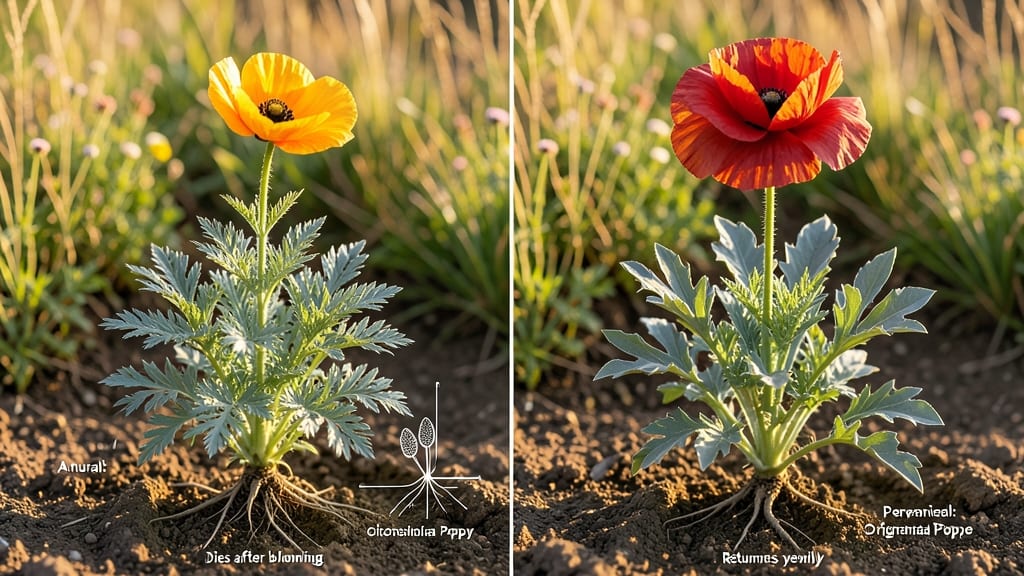
Poppies are mostly annuals or biennials, but some varieties like the Iceland poppy act as short-lived perennials. After flowering, they often die back to the ground while their roots stay alive, ready to sprout again when conditions improve.
Most poppies complete their entire life cycle in just one growing season, which is why they're classified as annuals. 🌸 However, a few hardy varieties like the Iceland poppy or California poppy can survive multiple years by storing energy in their roots during dormancy.
This dieback behavior—where the plant appears dead after blooming—is actually a survival strategy that lets them bounce back when spring returns. The key difference between annuals and perennials lies in how long their roots can remain viable underground.
Understanding this cycle helps gardeners plan better. For example, if you're growing poppies for continuous color, you'll want to plant new seeds each year for annual varieties, while perennial types may reward you with spontaneous regrowth in subsequent seasons.
The secret to encouraging this regrowth lies in providing well-draining soil and avoiding overwatering during dormancy.
💡 In This Article
- Poppy Growth Cycles: Annual vs Perennial Traits Explained
- How to Extend Poppy Blooms: Gardening Tips for Longer-Lasting Flowers
Poppy growth cycles: annual vs perennial traits explained
The botanical distinction between annual and perennial poppies comes down to their root systems and how they handle energy storage. Annual poppies like the opium poppy (Papaver somniferum) complete their entire life cycle—from seed to flower to seed production—in just 60-90 days.
Their roots store minimal energy and typically decompose after flowering, leaving no persistent structure for regrowth. This rapid life cycle is an adaptation to maximize reproduction before environmental conditions (like drought or frost) become unfavorable.
In contrast, perennial poppies such as the Iceland poppy (Papaver nudicaule) or California poppy (Eschscholzia californica) develop robust taproots that can store carbohydrates and nutrients for 2-5 years or more.
These roots remain dormant during harsh seasons but can regenerate shoots when temperatures rise above 50°F (10°C) and daylight increases. The dieback you observe after flowering is actually a survival mechanism—above-ground growth halts to conserve energy, while the root system remains active underground, ready to sprout when conditions improve.
The key environmental trigger for this behavior is photoperiodism—the plant's response to daylight length. Most poppies require 12-14 hours of daylight to trigger flowering, after which they enter a natural senescence (aging) phase. Annuals complete this cycle entirely, while perennials pause above-ground growth but maintain root viability.
This is why you might see "volunteer" poppies popping up in your garden years after initial planting—the roots were patiently waiting for the right conditions to return.
Temperature also plays a critical role in this cycle. Annual poppies often germinate in spring, flower in summer, and die back by early fall, unable to withstand winter frosts. Perennial varieties, however, can tolerate colder climates by entering a deep dormancy phase.
For example, Iceland poppies can survive temperatures down to -20°F (-29°C) thanks to their hardy root systems, making them ideal for gardeners in cooler regions who want long-term blooms.
What most gardeners don't realize is that even "annual" poppies may produce seeds that lie dormant in the soil for 1-3 years before germinating—a phenomenon called secondary dormancy. This explains why you might suddenly see poppies appearing in garden beds years after the original plants have died back.
The seeds were patiently waiting for the perfect combination of moisture, temperature, and light to break their dormancy cycle.
Understanding these growth patterns helps explain why some poppies seem to "come back" year after year while others disappear entirely after their first bloom. The difference lies in how well their root systems can store and protect energy reserves during dormancy.
For gardeners, this knowledge translates to strategic planting—knowing whether to expect annual renewal or perennial persistence can completely change how you approach poppy cultivation in your landscape.