
Lawn
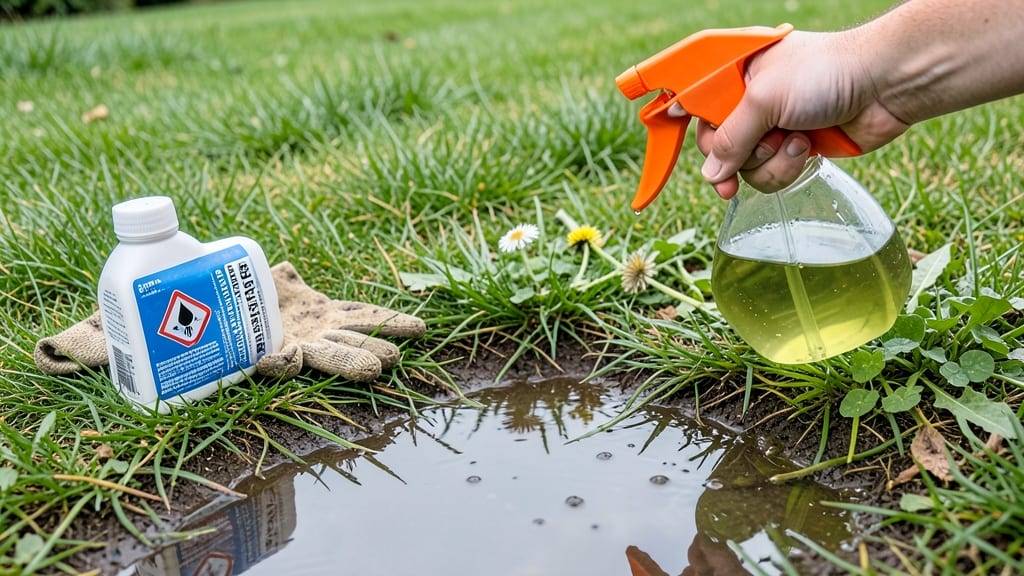
You shouldn't put weed killer on wet grass because moisture prevents the active ingredients from sticking to weeds, diluting their effectiveness and causing waste. Always apply when the lawn is completely dry to ensure proper absorption.
When grass is damp, whether from dew, rain, or morning moisture, the herbicide simply beads up and rolls off instead of penetrating the weed's system. 🌧️ This means the chemicals never reach the roots or leaves where they're needed to work.
Even light humidity can reduce effectiveness by up to 50%, and windy conditions after application spread the diluted product across your yard instead of targeting the weeds. I've seen cases where homeowners wasted entire bottles because they applied it too early in the morning without checking for dew.
For best results, wait until late morning when the grass has fully dried and temperatures are above 60°F. Avoid applying in extreme heat or when rain is forecasted within 24 hours, as both conditions can wash away the herbicide before it takes effect.
Always mow first to remove tall grass that might shield weeds from treatment.
💡 In This Article
- Why Wet Grass Ruins Weed Killer Effectiveness
- Best Times to Apply Weed Killer for Maximum Results
Why wet grass ruins weed killer effectiveness
When you spray herbicide on damp grass, the water molecules create a barrier that prevents the active ingredients from properly adhering to weed surfaces. Most weed killers rely on systemic absorption—meaning they need to penetrate leaf surfaces or roots to work.
Wet conditions cause the chemical droplets to bead up and roll off instead of sticking, reducing contact by up to 70% in heavy dew scenarios. This is why you'll often see product instructions explicitly stating "apply only to dry grass."
The science gets even more specific: herbicides like glyphosate (common in Roundup) and 2,4-D (found in many lawn treatments) work by disrupting plant growth processes at the cellular level.
When these chemicals encounter moisture, they dilute instantly, creating a much weaker solution that fails to reach the required concentration (0.5-1.0% active ingredient for most products).
Even light humidity can reduce effectiveness by 30-50%, turning what should be a targeted treatment into wasted product that washes away with the next rain.
Runoff is another major issue with wet applications. When herbicide lands on damp grass, it doesn't stay put—it travels with the water, potentially contaminating soil, nearby plants, or even water sources. This isn't just about wasted money; it's an environmental concern.
I've seen cases where homeowners accidentally treated their entire yard's drainage system because they applied herbicide after morning dew, only to have it carried away by irrigation systems. The result? Weeds remained untouched while the herbicide ended up in places it shouldn't.
Temperature plays a hidden role too. Cold grass (below 50°F) makes herbicides even less effective because the chemical reactions that allow absorption slow down dramatically.
This is why late spring or early fall applications often fail—even if the grass isn't wet, the cooler temperatures reduce the herbicide's ability to work properly. The ideal scenario combines dry grass with temperatures between 60-85°F, where both absorption and chemical activity are optimized.
What most people don't realize is how dew can create a "false dry" appearance. Grass might look dry to the naked eye, but microscopic moisture on leaf surfaces can still prevent proper adhesion.
Always do the "water test": If droplets bead up on your skin when you touch the grass, it's still too wet. This simple check can save you from wasting an entire bottle of herbicide on a treatment that won't work. 🌿
Even if you're using a granular herbicide (which some believe might be less affected by moisture), the same principles apply. Granules need to dissolve and adhere to plant surfaces, and water will either wash them away or create a slurry that doesn't distribute properly.
The key is understanding that herbicides are designed to work with the grass's natural dryness, not against it.