
Pests
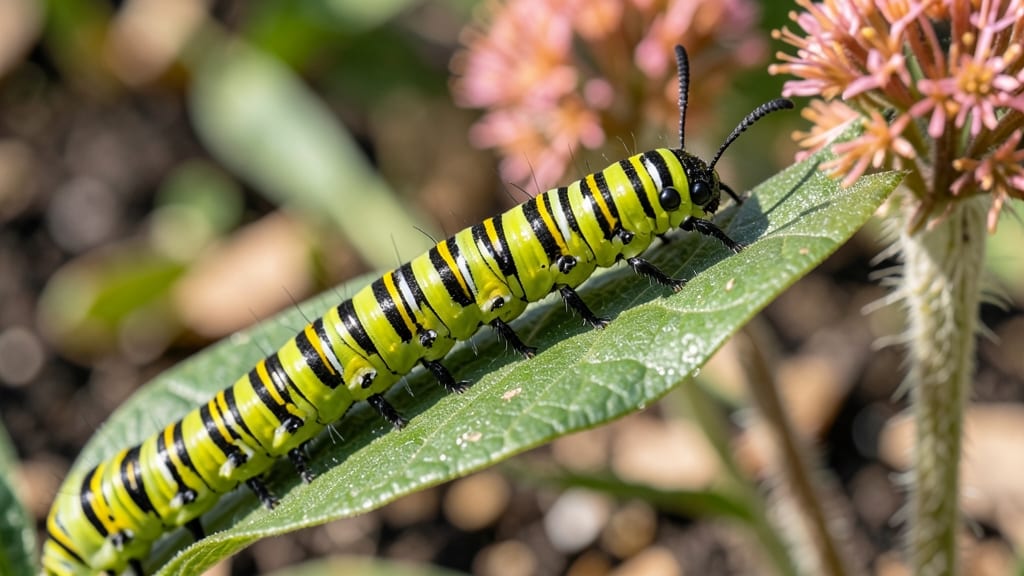
Monarch caterpillars find milkweed by detecting specialized chemical signals: asclepiadin compounds in leaves and stems act as host-plant markers, while their antennae pick up volatile organic compounds released by milkweed up to 15 feet away.
Monarch caterpillars are born with an innate ability to locate milkweed through their olfactory system, which is far more sensitive than ours. 🌿 These tiny insects can detect specific chemical signatures in the air, allowing them to zero in on milkweed even when surrounded by other plants.
The asclepiadin compounds in milkweed leaves create a unique "scent trail" that acts like a homing beacon, while the volatile organic compounds serve as an early warning system.
Interestingly, this chemical communication is so precise that caterpillars can distinguish between milkweed species, ensuring they find the most nutritious host plants for their development.
What makes this mechanism even more fascinating is that monarch caterpillars don't rely solely on visual cues—they use this chemical navigation even in dense foliage. This explains why they can locate milkweed patches in gardens or natural habitats with remarkable accuracy, often before adult butterflies arrive to lay eggs.
The process begins when a female monarch lays eggs on milkweed leaves, but the caterpillars' ability to find their food source is hardwired into their biology from the moment they hatch.
💡 In This Article
- Chemical Compounds That Guide Monarch Caterpillars to Milkweed
- Creating a Monarch-Friendly Garden: Plant Placement and Attracting Milkweed
Chemical compounds that guide monarch caterpillars to milkweed
The monarch caterpillar's ability to find milkweed begins with specialized chemical compounds called asclepiadins, which are unique to the milkweed family (Asclepiadaceae). These compounds are produced in milkweed leaves and stems, creating a distinctive chemical signature that acts as a host-plant marker.
When a caterpillar hatches, its antennae—covered with thousands of sensory receptors—detect these compounds at concentrations as low as 0.001 micrograms per square centimeter of leaf surface. This sensitivity allows them to identify milkweed even when surrounded by other plants that lack these specific chemical cues.
Volatile organic compounds (VOCs) play an equally critical role in this navigation system. Milkweed plants release these airborne chemicals, which can travel up to 15 feet through the air.
The caterpillars' antennae contain specialized olfactory receptors tuned to detect these VOCs, including compounds like hexanal and linalool, which are released in higher concentrations when milkweed leaves are damaged.
This dual detection system—both the asclepiadins on the plant surface and the VOCs in the air—creates a chemical "map" that guides the caterpillars directly to their food source. 🌿
What makes this mechanism so precise is that monarch caterpillars are hardwired to ignore other plants.
For example, while some butterflies lay eggs on a variety of host plants, monarch caterpillars will only survive on milkweed because their digestive systems are adapted to break down the plant's toxins, like cardenolides.
This chemical specificity ensures that even in a garden with diverse vegetation, the caterpillars will instinctively seek out milkweed, demonstrating nature's finely tuned survival strategies.
The caterpillars' ability to detect these compounds is so refined that they can distinguish between different milkweed species. For instance, common milkweed (Asclepias syriaca) and swamp milkweed (Asclepias incarnata) produce slightly different VOC profiles, allowing caterpillars to choose the most nutritious option.
This level of chemical discrimination is rare in the insect world and highlights the evolutionary arms race between monarchs and milkweed, where the plant's toxins protect it from most herbivores while the caterpillars have adapted to thrive on it.
Interestingly, the caterpillars' antennae are not just passive detectors—they actively process these chemical signals in their brains. Studies using electroantennography (a technique that measures electrical responses in antennae) have shown that monarch caterpillars exhibit stronger neural responses to milkweed VOCs than to those of other plants.
This neural specialization ensures that even a single whiff of milkweed can trigger a feeding response, making their navigation system both efficient and highly reliable. 🔬
This chemical guidance system is so effective that monarch caterpillars can locate milkweed even in dense forests or urban gardens. The combination of asclepiadins and VOCs creates a "scent trail" that the caterpillars follow with remarkable accuracy, often finding their way to milkweed patches within minutes of hatching.
This ability is not just a biological curiosity—it's a critical survival mechanism that ensures the next generation of monarchs has access to the food they need to grow and develop.