
Planting
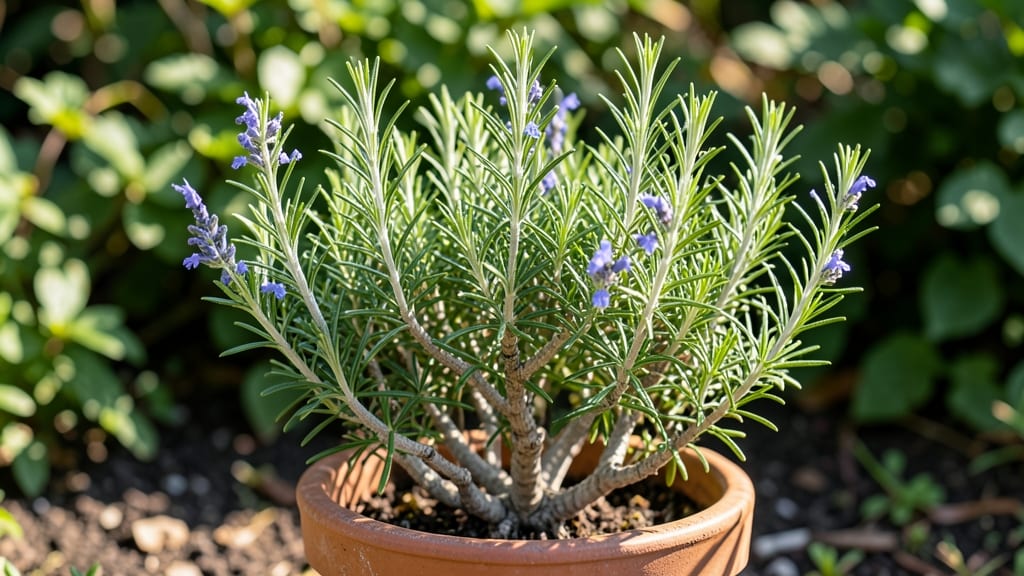
A rosemary plant is a perennial in warm climates but behaves as an annual or short-lived perennial in colder zones, dying back to the ground in frost before regrowing from its hardy root system when conditions improve.
A rosemary plant's lifespan depends entirely on your climate zone.
In frost-free regions (USDA zones 8-11), it thrives as a true perennial, growing year-round with minimal care. 🌿 However, in colder zones (3-7), the woody stems may die back completely during winter, but the roots survive underground—ready to sprout fresh growth once temperatures rise.
This "dieback" behavior is why many gardeners treat rosemary as an annual in northern climates, even though it's technically a hardy perennial with the right protection.
What sets rosemary apart is its ability to regenerate from just a few inches of root left in the ground. Unlike true annuals that must be replanted each year, rosemary's persistent root system makes it a semi-perennial in marginal climates.
With proper winter care—like mulching or container overwintering—you can coax it back year after year, sometimes for a decade or more.
💡 In This Article
- Rosemary’s Perennial Survival in Different Climates
- Protecting Rosemary Through Winter for Long-Term Growth
Rosemary’s perennial survival in different climates
Rosemary's perennial status hinges on your climate's USDA hardiness zone, where zones 8-11 (average minimum temperatures above 20°F) allow it to thrive year-round as a true perennial. In these frost-free regions, rosemary grows continuously, developing woody stems and aromatic foliage without seasonal dormancy.
The plant's deep root system—capable of extending 3-5 feet downward—anchors it firmly, drawing moisture from deep soil layers even during dry spells. 🌱
In colder zones (3-7), where winter temperatures drop below 15°F, rosemary enters a state of seasonal dieback. The above-ground woody stems freeze and blacken, but the root crown (the thickened base where roots meet stems) remains alive beneath the soil.
This root system is remarkably resilient—studies show rosemary roots can survive down to -20°F if protected by organic mulch or snow cover. The key difference? True perennials like lavender regrow from their base, while rosemary's regrowth often emerges from lateral buds along the remaining root structure.
What most gardeners miss is how rosemary's woody growth habit affects its survival. Unlike herbaceous perennials (like thyme) that die back to ground level, rosemary's rigid stems create insulation around the root crown.
This natural protection explains why a 3-inch layer of straw mulch can extend survival by 5-10°F in marginal climates. The trade-off? Without protection, the first frost often kills the stems, making it appear dead—yet the roots may still hold 90% viability for spring regrowth.
Consider this comparison: In Zone 8, rosemary may lose 20% of its foliage in winter but regrows fully by spring. In Zone 5, the same plant might lose all stems but still push new growth if the roots survive.
The critical threshold is consistent below-zero temperatures for more than 3 weeks—this duration often determines whether rosemary acts as a perennial or behaves like an annual. 🌡️
Rosemary's survival strategy relies on secondary growth—its ability to produce new shoots from dormant buds along the root crown. These buds remain viable even after severe cold because they're protected by the plant's natural antifreeze compounds (like proline amino acids) that prevent cellular damage.
This is why you'll often see rosemary "coming back" from what looks like total death—it's not a true annual, but rather a woody perennial in suspended animation.
For gardeners in transitional zones (6-7), the key takeaway is that rosemary's perennial nature depends on root protection, not just air temperature. A 6-inch deep planting hole with well-draining soil and insulating mulch can make the difference between a plant that dies back and one that thrives for years.
The deeper the roots, the better their chance to survive winter's harshest conditions.
What's fascinating is how rosemary's aromatic compounds (like rosmarinic acid) actually enhance cold tolerance. These same compounds that give rosemary its signature piney scent also act as natural antioxidants, protecting cell membranes during freeze-thaw cycles.
This dual-purpose biology explains why rosemary often outlasts less hardy herbs in the same climate zone. 🌿