
Flowers
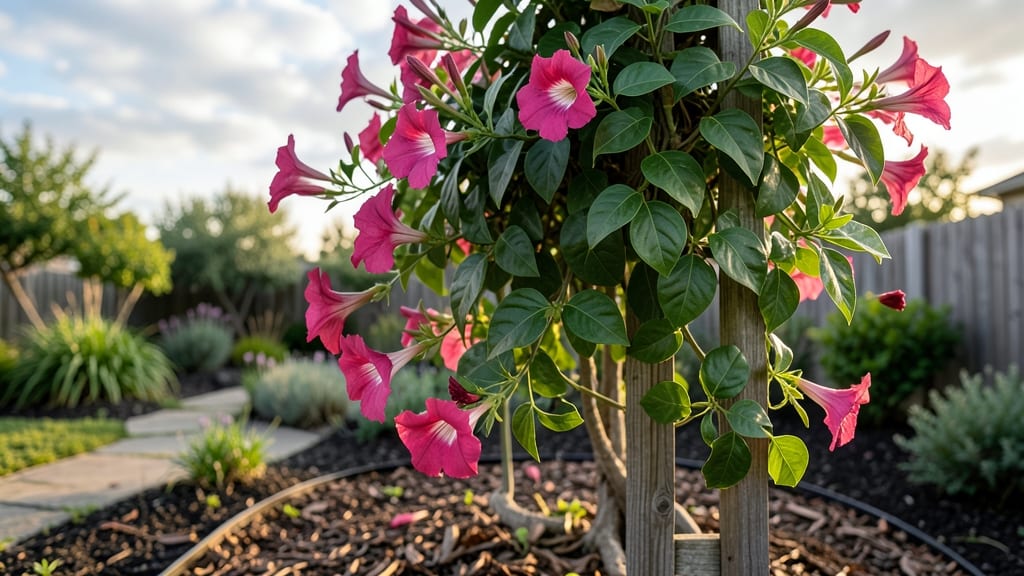
Mandevilla is not a true perennial in cold climates, as it dies back to the ground when temperatures drop below 30°F (-1°C), though it can regrow from roots in warmer zones like USDA 9-11. In frost-free areas, it thrives year-round as a woody shrub, but colder regions require winter protection or replanting annually.
Mandevilla's tropical origins explain why it behaves like a seasonal plant in cooler areas.
Unlike hardy perennials, its above-ground growth freezes solid when temperatures dip below 30°F (-1°C), but the roots often survive in milder zones like USDA 9-11. 🌱 This makes it more of a "semi-perennial" in marginal climates—it comes back from dormancy if protected properly.
The key difference lies in its ability to regenerate from roots rather than surviving winter intact like true perennials.
What sets mandevilla apart is its adaptability when given proper care. In frost-free regions, it grows as a vigorous woody shrub year-round, while gardeners in colder zones must either dig up tubers for indoor storage or provide heavy mulch and frost blankets during winter months.
The plant's resilience in warmer areas makes it a popular choice for container gardening, where it can be moved indoors before the first frost.
💡 In This Article
- Mandevilla’s Cold Hardiness and Growth Habits
- Winter Care Strategies for Mandevilla in Cold Climates
Mandevilla’s cold hardiness and growth habits
Mandevilla’s frost sensitivity stems from its tropical origins in South America, where temperatures rarely drop below 50°F (10°C). Its cells lack the protective mechanisms of cold-hardy perennials, like antifreeze proteins or thick bark insulation.
When exposed to 30°F (-1°C) or lower, the plant’s water content freezes and expands, rupturing cell walls in a process called cryodamage. This explains why even brief cold snaps can kill back the plant’s stems and leaves, though the roots often remain viable in milder zones.
The plant’s growth habit shifts dramatically with temperature. In frost-free regions like USDA zones 9-11, mandevilla grows as a woody shrub, developing thick stems and lush foliage year-round. However, in cooler zones (USDA 8 and below), it behaves more like an annual, dying back completely above ground.
The roots can survive in USDA 9-11 because they’re buried deeper, insulated by soil and organic matter, while the stems are more vulnerable due to their thinner, less lignified structure.
Here’s what happens at the cellular level: Mandevilla’s tropical cells contain high moisture content (around 70-80% water by weight), which makes them susceptible to ice crystal formation. Unlike cold-hardy plants that produce protective sugars or proteins, mandevilla’s cells lack these adaptations.
When temperatures drop, the plant enters a state of dormancy, but only the roots remain active enough to regenerate in spring—if protected from prolonged freezing.
What most gardeners don’t realize is that mandevilla’s root system can survive brief exposure to 20°F (-7°C) if the ground isn’t frozen solid. The key is moisture retention—the roots stay alive as long as they’re not dehydrated by dry soil or frozen for extended periods.
In USDA 8, gardeners often report success with heavy mulching (using 4-6 inches of straw or leaves) to insulate the roots, while in USDA 7 and colder, digging up tubers becomes necessary for survival.
Consider this comparison: A cold-hardy perennial like peony can withstand -20°F (-29°C) because its buds are packed with protective compounds. Mandevilla, however, has no such defenses—its survival hinges entirely on environmental conditions.
This is why it’s classified as a tender perennial: it can live multiple years if protected, but it’s not built to survive winter exposure like true perennials.
The plant’s ability to regrow from roots in warmer zones is a testament to its resilience, not its hardiness. In USDA 9-11, where winters rarely drop below 30°F (-1°C), mandevilla can thrive as a perennial because the roots remain undisturbed.
But in colder climates, even a single hard frost can kill back the entire plant above ground, requiring gardeners to intervene with protective measures or replant annually.