
Flowers
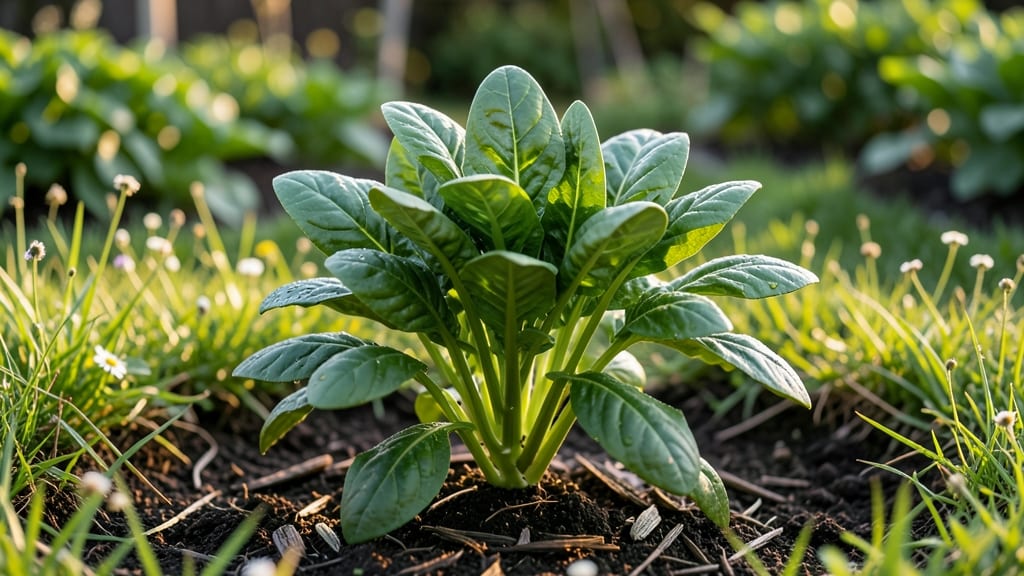
Spinach is not a true perennial—it grows as a cool-season annual or biennial, dying back in heat or after producing seeds. However, some varieties may regrow from the crown if overwintered in mild climates with proper care.
Spinach's classification as a biennial means it typically completes its life cycle in two years, though most gardeners treat it as an annual because it bolts (goes to seed) quickly in warm weather. 🌱 The key to extending its life lies in climate and variety—cool-season types like 'Winter Bloomsdale' or 'Tyee' handle frost better than heat-tolerant varieties.
Even then, true perennial behavior requires specific conditions, like heavy mulching or container growing in zones with mild winters.
What sets spinach apart is its ability to produce a second harvest the following year from the same crown, but this only works if you protect it from extreme cold or heat stress.
Many gardeners successfully overwinter spinach by covering beds with straw or row fabric, though it's not a guaranteed strategy—some plants simply won't survive the transition. The bottom line? Spinach behaves more like a short-lived perennial in ideal conditions, but don't count on it lasting multiple years without effort.
💡 In This Article
- Spinach’s Growth Cycle: Annual vs Biennial Behavior
- Overwintering Spinach: Techniques for Prolonged Harvests
Spinach’s growth cycle: annual vs biennial behavior
Botanically, spinach (Spinacia oleracea) is classified as a biennial plant, meaning its life cycle spans two growing seasons under ideal conditions. In its first year, it focuses on leaf production, storing energy in its thickened crown.
During the second year, it bolts (sends up a flower stalk) and produces seeds before dying—unless harvested first. However, most gardeners treat spinach as an annual because it bolts rapidly when exposed to long daylight hours (14+ hours) and temperatures above 75°F, which triggers its reproductive phase prematurely. 🌱
The transition from leafy growth to flowering is controlled by a plant hormone called florigen, which is triggered by environmental cues. For example, varieties like 'Bloomsdale Long Standing' may survive mild winters but still bolt in spring if daytime temperatures climb above 70°F.
Even cold-hardy types like 'Winter Bloomsdale' won't persist beyond two years without intervention, as their crowns weaken after producing seeds. This explains why spinach rarely behaves as a true perennial—its energy is redirected toward reproduction rather than vegetative growth.
What confuses many gardeners is spinach's ability to regrow from the crown after overwintering. This happens because the plant's basal leaves (those growing from the crown) remain dormant but viable through winter if protected from freezing. However, this regrowth isn't true perennial behavior—it's more like a short-term survival strategy.
The crown itself is a modified stem (not a true root system), so it lacks the deep, persistent roots of plants like asparagus or rhubarb, which can regenerate for decades. 💫
Another factor is spinach's sensitivity to vernalization (cold treatment), which some varieties require to flower. Without proper cold exposure, biennial spinach may never bolt, continuing to produce leaves like an annual.
This is why gardeners in warm climates often harvest spinach as an annual—it simply doesn't get the cold signals needed to trigger its second-year flowering. In contrast, in colder regions, spinach might complete its biennial cycle naturally, though it rarely survives beyond two years without human intervention.
Consider this comparison: True perennials like kale or Swiss chard have fibrous root systems that regenerate year after year, while spinach relies on its crown and basal leaves.
Even with overwintering, spinach's crown weakens after 12-18 months, making it more accurate to call it a short-lived perennial rather than a true one. The key difference lies in its inability to regenerate from roots or underground stems, which are hallmarks of perennial plants.
For practical purposes, spinach behaves like an annual in most home gardens because it bolts quickly and doesn't persist beyond its first growing season. However, in controlled environments—like greenhouses or with heavy mulching—some varieties can produce a second harvest the following year.
This is why gardeners often refer to spinach as a "semi-perennial" in mild climates, where it can survive winter but rarely thrives for more than two years. 🌿