
Pests
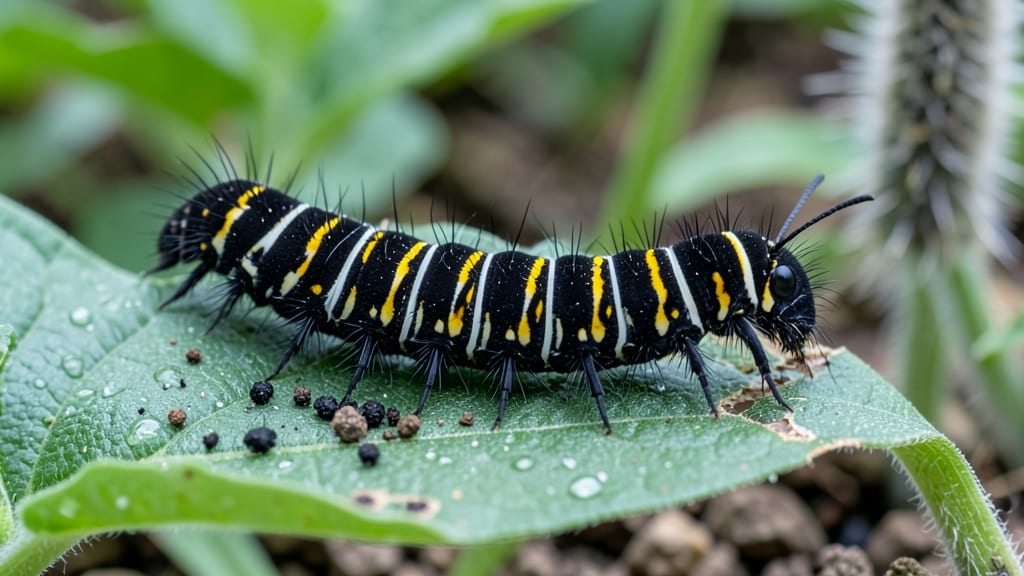
Milkweed butterfly caterpillars are the larval stage of monarchs and queen butterflies, feeding exclusively on milkweed plants during their rapid growth phase before pupating into chrysalises. Their bright yellow, black, and white stripes warn predators of their toxicity, derived from milkweed sap.
These striped caterpillars undergo one of nature's most dramatic transformations. 🌿 The monarch caterpillar, for example, grows from a tiny egg to a 2-inch larva in just 2-3 weeks, consuming milkweed leaves voraciously.
This rapid growth phase is critical—they must store enough energy to survive metamorphosis into their chrysalis stage, where they'll remain for 10-14 days before emerging as adult butterflies.
What's fascinating is how their vibrant warning colors serve as a natural defense mechanism, deterring predators through visual cues about their toxic nature.
The relationship between these caterpillars and milkweed plants is a classic example of co-evolution. The plants produce toxic compounds called cardenolides, which the caterpillars not only tolerate but store in their bodies.
This chemical defense makes them unappetizing to birds and other predators, ensuring their survival until they complete their life cycle. Many gardeners plant milkweed specifically to support monarch populations, creating vital habitats for these iconic butterflies.
💡 In This Article
- Monarch Caterpillar Development Stages Explained
- Best Milkweed Varieties for Hosting Butterfly Larvae
Monarch caterpillar development stages explained
The monarch caterpillar's journey begins when a female butterfly lays 250-400 eggs during her 2-6 week lifespan, typically on the underside of milkweed leaves. These tiny, oval eggs—just 1mm wide—hatch in 3-8 days depending on temperature, with warmer conditions (80°F) accelerating development.
The newly emerged caterpillars immediately start feeding on milkweed leaves, which contain toxic cardenolides that they'll later use as their own defense mechanism.
During the larval stage, caterpillars undergo 5 molts as they grow from 2mm to 2 inches in length. Their rapid growth requires consuming 25-50 times their body weight in milkweed leaves daily—a process that takes 10-14 days at optimal temperatures.
The bright yellow, black, and white banding serves as an aposematic warning, signaling to predators that these caterpillars are toxic due to the milkweed's chemical defenses. 🌟 This coloration is so effective that even birds avoid them after just one bad experience.
After reaching full size, the caterpillar forms a chrysalis by attaching itself to a milkweed stem or leaf. Inside this protective casing, a complete metamorphosis occurs over 10-14 days, where the caterpillar's body breaks down into a soupy liquid that reorganizes into butterfly structures.
Temperature plays a critical role here—colder conditions can extend the chrysalis stage to 2-3 weeks, while warmer temperatures may shorten it to just 7 days. The newly emerged adult butterfly then pumps fluid into its wings to expand them before taking its first flight.
Each stage of development is finely tuned to environmental conditions. For example, monarchs born in late summer may enter a hibernation-like state called diapause, delaying their metamorphosis until spring when food sources are more abundant. This adaptation allows them to survive winter and continue their life cycle.
The entire process from egg to adult butterfly typically takes 30-45 days, though this can vary significantly based on regional climate and milkweed availability.
What's particularly fascinating is how these caterpillars manage to consume milkweed's toxic sap without harming themselves. Their gut contains specialized enzymes that break down the cardenolides, while their skin absorbs the compounds to store as a defense mechanism.
This chemical relationship between the caterpillars and milkweed is a perfect example of mutual adaptation—one species evolves to exploit the other, which in turn develops new defenses. 🌿 The result is a striking display of nature's intricate balance and survival strategies.
Understanding these developmental stages helps gardeners and conservationists create optimal habitats. Planting milkweed at the right time ensures caterpillars have fresh leaves when they emerge, while providing shelter from predators and temperature extremes can significantly improve survival rates.
The entire life cycle demonstrates how interconnected these species are with their environment, making milkweed gardens vital for supporting monarch populations.