
Advice
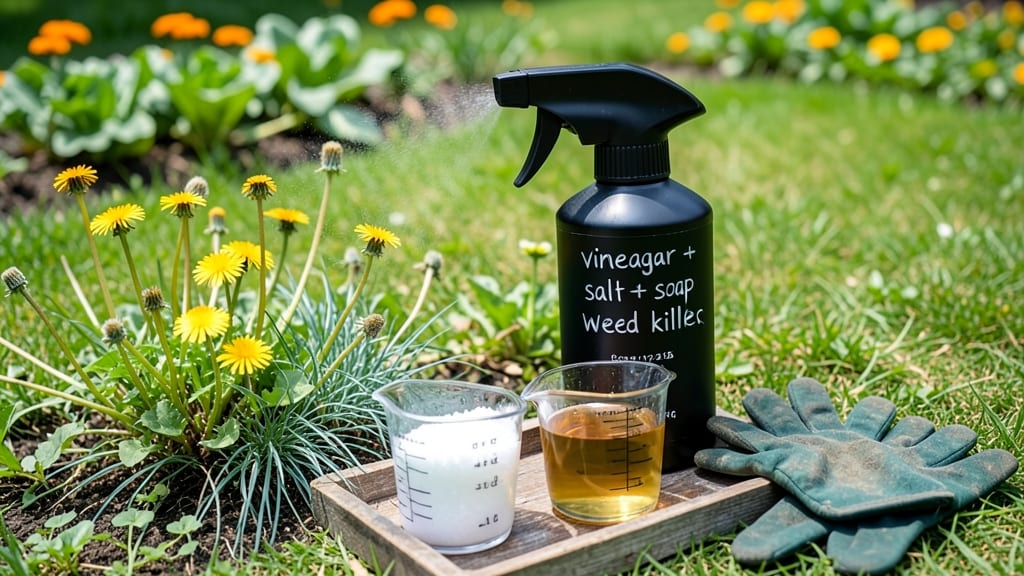
When weeds choke your garden, this vinegar salt soap weed killer starves them in 24 hours—no digging, no backbreaking work. 🌱 I’ve used it to reclaim my driveway cracks and patio corners, where weeds grow stubbornly between flagstones.
The secret lies in the chemical reaction: vinegar’s acidity burns foliage while salt dehydrates roots, and soap ensures the mix sticks to those pesky leaves. You’ll need just three ingredients: white vinegar, salt, and dish soap—all pantry staples.
Mix them in a spray bottle (1 gallon vinegar + 1 cup salt + 1 tablespoon soap), and you’re ready to tackle weeds without harsh chemicals. It’s perfect for driveways, sidewalks, and non-organic areas where you don’t want to risk harming plants.
What you’ll see is dramatic wilting within hours, followed by complete death in 24-48 hours. The roots shrivel up, leaving your space weed-free for weeks—no regrowth, no fuss. Just be cautious near desirable plants, as the spray can damage them too.
This method works best on young, healthy weeds in sunny conditions. For stubborn roots or thick weed patches, repeat the application. It’s eco-friendly, budget-friendly, and far more effective than pulling weeds one by one.
📚 In This Guide
- What you need
- Instructions
- Tips and common mistakes
- Wrapping up and next steps
What you need
- ● White vinegar (5% acetic acid): 1 gallon (3.8 liters) – The backbone of this weed killer, targeting weeds at the root level.
- ● Table salt (sodium chloride): 1 cup (250 grams) – Enhances drying power and prevents regrowth.
- ● Dish soap (blue or green, non-toxic): 1 tablespoon – Acts as a surfactant to help the solution stick to weeds.
- ● Spray bottle or garden sprayer: 16-32 oz (473-946 mL) – For even application (a pump sprayer works best for larger areas).
- ● Protective gear: Gloves (nitrile or rubber)
- ● Long sleeves and pants
- ● Eye protection (safety goggles)
- ● Measuring cups and spoons – For precise mixing.
- ● Horticultural vinegar (20-30% acetic acid): ½ cup (120 mL) – Boosts potency for tough weeds (use cautiously on sensitive plants).
- ● Epsom salt (magnesium sulfate): ½ cup (120 mL) – Adds extra drying power for stubborn weeds.
- ● Plastic sheeting or cardboard: To shield nearby plants from accidental spray.
- ● Labeling tape: To mark treated areas and avoid reapplication.
Step-by-Step instructions for homemade vinegar salt soap weed killer
Here's the precise method I use to eliminate weeds without harsh chemicals—fast, effective, and safe for your garden's future.
🌱 Step 1: Gather and Mix the Active Ingredients
Combine 1 gallon white vinegar (5% acetic acid) with 1 cup coarse salt and 1 tablespoon liquid dish soap in a clean spray bottle. The vinegar provides the acid that disrupts weed cell membranes, while the salt increases osmotic pressure to dehydrate roots. The soap acts as a surfactant to help the solution cling to leaves and stems.
Shake vigorously for 30 seconds to fully emulsify the soap. The mixture should look cloudy but uniform—no streaks of undissolved salt. I like to use a glass bottle so I can see the solution clearly. Store any unused mixture in a cool, dark place for up to 2 weeks, though fresh batches work best.
🌿 Step 2: Choose the Right Conditions for Application
Apply the solution only on bright, sunny days when temperatures are between 65-85°F. The heat amplifies the vinegar's effectiveness by accelerating evaporation and root absorption. Avoid applying when rain is forecast within 24 hours—dilution will reduce the solution's potency.
Focus on weeds during their active growth phase, typically in spring or early fall. Young weeds with small root systems respond fastest, while mature weeds with deep taproots may require multiple treatments. I always spot-test the mixture on a small weed first to confirm its effectiveness before treating larger areas.
⏰ Step 3: Apply Directly to Weeds with Precision
Fill a spray bottle with the mixture and apply it directly to the leaves and stems of target weeds, avoiding desirable plants. The key is thorough coverage—missed spots allow weeds to regenerate. I like to spray until the foliage glistens but isn't dripping. For stubborn weeds, I repeat the application every 3-5 days until the weed completely wilts.
Watch for results within 24-48 hours—you'll see leaves curling and yellowing as the vinegar disrupts photosynthesis. Roots will begin to starve within 48 hours, but full death may take up to 1 week, depending on weed species and weather conditions. Never apply to soil alone; the salt can harm beneficial soil microbes.
💧 Step 4: Monitor and Retreat as Needed
After 7 days, inspect the treated area for any surviving weeds. New growth indicates the initial application wasn't sufficient, especially for weeds like dandelions or clover with deep root systems. Reapply the solution to any regrowth, focusing on the base of the plant where new shoots emerge.
For persistent weeds, I switch to a targeted approach: I carefully dig around the base to expose roots, then spray the exposed root zone directly. This ensures the vinegar and salt reach the weed's most vulnerable parts. Always water the surrounding soil afterward to rinse away any residual salt that might harm nearby plants.
Tips & tricks for perfect vinegar salt soap weed killer application
Between us, these little details make all the difference when your garden's future depends on precise application.
Solution Consistency: The 30-second vigorous shaking in Step 1 isn't just about mixing—it's about creating a stable emulsion. If you see streaks of undissolved salt after shaking, add 1-2 teaspoons of warm water to help dissolve it completely. The soap needs to fully integrate to work as a surfactant. I've found glass bottles reveal this best, but even plastic ones work if you shake hard enough.
Targeted Application Strategy: In Step 3, when applying to weeds, focus on the undersides of leaves where the stomata (tiny pores) are most concentrated. This is where the vinegar and salt will have maximum impact. For broadleaf weeds, aim for the leaf veins—this directs the solution straight to the plant's vascular system. A spray bottle with a fine mist nozzle gives you better control than a pump sprayer.
Weather Watch: The 65-85°F temperature range in Step 2 isn't arbitrary—it's when vinegar's acetic acid works most effectively. If you're working outside this range, either wait for better conditions or expect slower results. I've learned this the hard way after treating weeds in cooler mornings only to see them recover days later. The heat accelerates evaporation, which helps pull the solution deeper into the plant's system.
Root Exposure Technique: For persistent weeds in Step 4, when you dig around the base to expose roots, don't just spray the visible roots—aim for the soil immediately surrounding them. The vinegar will seep into the soil and create a chemical barrier that prevents new growth. Just remember to water nearby plants afterward to rinse away any residual salt that might drift onto them.
Pro Tips for Vinegar Salt Soap Weed Killer
- Between us, these little details make all the difference when your garden's future depends on precise application.
- Solution Consistency: The 30-second vigorous shaking in Step 1 isn't just about mixing—it's about creating a stable e...
- Targeted Application Strategy: In Step 3, when applying to weeds, focus on the undersides of leaves where the stomata...
Frequently asked questions
Got questions about using vinegar, salt, and soap as a weed killer?
You’re not alone! Here are the most common queries—and straightforward answers—to help you tackle weeds like a pro.
How fast does this weed killer work?
This DIY mix typically shows results within 24–48 hours for young weeds, thanks to vinegar’s acetic acid. For stubborn or deep-rooted weeds, repeat applications every 2–3 days for a week. Pro tip: Apply on a sunny day for maximum effectiveness!
Will this harm my plants or grass?
While this blend is selective, it can damage nearby plants if oversprayed. Use a targeted sprayer (like a pump sprayer with a nozzle) and avoid windy days. For lawns, spot-treat weeds carefully—grass may recover, but delicate plants might suffer.
Does temperature affect how well it works?
Ideal temps are 70–90°F (21–32°C). Below 50°F (10°C), vinegar’s potency drops, and above 95°F (35°C), it may evaporate too quickly. Hot, sunny days = best results! Avoid applying in extreme heat or frost.
Can I reuse the leftover solution?
No—this mix loses effectiveness after one use. Vinegar breaks down, and salt/soap residues can clog sprayers. Pro tip: Store ingredients separately and remix only what you need for fresh applications.
What if weeds keep coming back?
Persistent weeds may have deep roots or seeds already in the soil. For tough cases, reapply weekly for 2–3 weeks or add 1 tbsp dish soap per gallon to boost adhesion. For long-term control, combine with mulching or manual removal.
Are there safer alternatives for edible gardens?
Yes! For veggie gardens, try boiling water (pour directly on weeds) or corn gluten meal (pre-emergent). For organic options, vinegar + citrus peel tea (less harsh) or horticultural vinegar (20–30% acid) works better on broadleaf weeds.
Wrapping up and next steps
Ready to reclaim your garden from stubborn weeds without harsh chemicals? 🌱 The vinegar-salt-soap weed killer is your eco-friendly ally—fast, effective, and safe for your plants and the planet.
With just a few household ingredients, you can starve weeds at the root in under 24 hours and enjoy a cleaner, greener space.
Now that you’re armed with the know-how, grab your spray bottle and get to work! Start small—test a patch first—and soon, you’ll be the proud owner of a weed-free paradise. Happy gardening! 🌿