
Pests
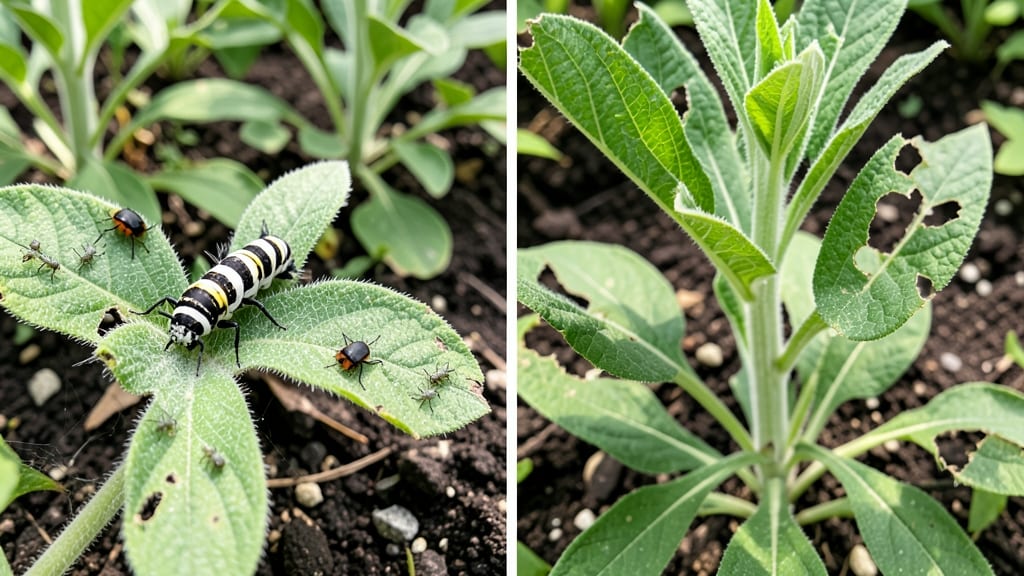
Monarch caterpillars primarily eat milkweed leaves, but other insects like aphids, milkweed beetles, and leafhoppers also consume them. Deer and rabbits may occasionally browse them, while adult monarch butterflies avoid the leaves entirely.
Milkweed's relationship with its eaters is fascinating because of its chemical defenses.
The plant produces toxic compounds called cardenolides, which deter most herbivores but are actually metabolized by monarch caterpillars, making them poisonous to predators. 🌿 This unique adaptation explains why you'll rarely see deer or rabbits heavily feeding on milkweed—they instinctively avoid its bitter taste.
Interestingly, while caterpillars thrive on the leaves, adult monarchs rely on nectar for energy, completely bypassing the toxic foliage that sustained them as larvae.
This specialized diet creates a delicate balance in ecosystems where milkweed grows. The plant's toxicity acts as a natural pest control for many insects, while still supporting the monarch's life cycle.
Understanding these dynamics helps gardeners make informed decisions about managing milkweed populations without accidentally harming the very creatures that depend on them.
💡 In This Article
- Monarch Caterpillars and Milkweed’s Toxic Defense
- Managing Milkweed Pests Without Harming Monarchs
Monarch caterpillars and milkweed’s toxic defense
The monarch caterpillar’s relationship with milkweed is a masterclass in chemical adaptation. These caterpillars consume cardenolides, toxic compounds produced by milkweed leaves, and convert them into a defense mechanism of their own.
While the toxins make milkweed unpalatable to most herbivores, monarch larvae store these compounds in their bodies, becoming toxic to predators like birds and small mammals. This process involves specialized enzymes that modify the cardenolides, making them less harmful to the caterpillar while retaining their deterrent properties.
Milkweed’s toxicity isn’t just a deterrent—it’s a survival strategy. The plant’s leaves contain up to 0.5-1.5% cardenolides by dry weight, which would be lethal to most insects.
However, monarch caterpillars have evolved to sequester these toxins, turning them into a protective armor. 🌟 For example, a single monarch caterpillar can consume up to 100 milkweed leaves in its 2-week larval stage, yet remain unaffected while becoming unappetizing to predators.
This chemical relationship is so specialized that monarchs can’t survive without milkweed, nor can milkweed thrive without monarchs to disperse its seeds.
Other herbivores avoid milkweed entirely due to these toxins. Deer and rabbits, which might nibble on young milkweed shoots, typically steer clear of mature leaves because the bitter taste signals danger. Even insects like aphids, which usually thrive on sap-sucking, find milkweed leaves too toxic to consume in large quantities.
The plant’s defense system creates a chemical arms race where only a few species, like monarchs, have evolved the biological tools to exploit it.
This ecological relationship extends beyond just survival. Monarch caterpillars play a crucial role in milkweed’s reproduction by pollinating flowers while feeding. Their bright orange and black coloration serves as a warning to predators: "I’m toxic—don’t eat me!"
This aposematic coloring is a visual cue that reinforces the chemical defenses, making the monarch one of nature’s most effective examples of co-evolution between plant and insect.
What’s truly remarkable is how this system protects the entire food chain. By making monarchs toxic, milkweed indirectly safeguards the caterpillars from predators, ensuring their survival to become butterflies that will continue the cycle.
Without this adaptation, milkweed would face far more herbivore pressure, and monarch populations would decline. 🦋 The plant’s toxicity isn’t just a defense—it’s the foundation of a thriving ecosystem.
For gardeners and ecologists, this relationship highlights the importance of preserving milkweed habitats. While other insects like aphids or beetles might damage milkweed plants, their presence is often a sign of a healthy ecosystem.
The key is balancing interventions—like using neem oil for aphids—to protect the plant without eliminating the very species that depend on it.